Samsung SDI series: Part 1 · Part 2 · Part 3
🇰🇷 한국어 원문 · Originally written in Korean on Oct 13, 2026. Charts are in Korean; key figures are restated in the text.
Summary
- Samsung SDI swung back to an operating profit of ₩203.8bn in 2Q26, its first in seven quarters. The stock is up 174% over the past year.
- Strip out a ~₩190bn tariff refund and ₩107.7bn of AMPC (US 45X production credits), and the core business still lost roughly ₩94bn.
- Sell-side 3Q26 estimates (~₩258bn) are about double consensus, but ex-GM JV compensation and AMPC, the quarter is roughly breakeven.
- The industry backdrop (EV to ESS, China out of the US supply chain) clearly favors SDI. The catch: 2027 earnings lean heavily on US tax credits.
- Part 1 of 3. Part 2 looks at where SDI sits in its turnaround; Part 3 covers valuation and my trading plan.
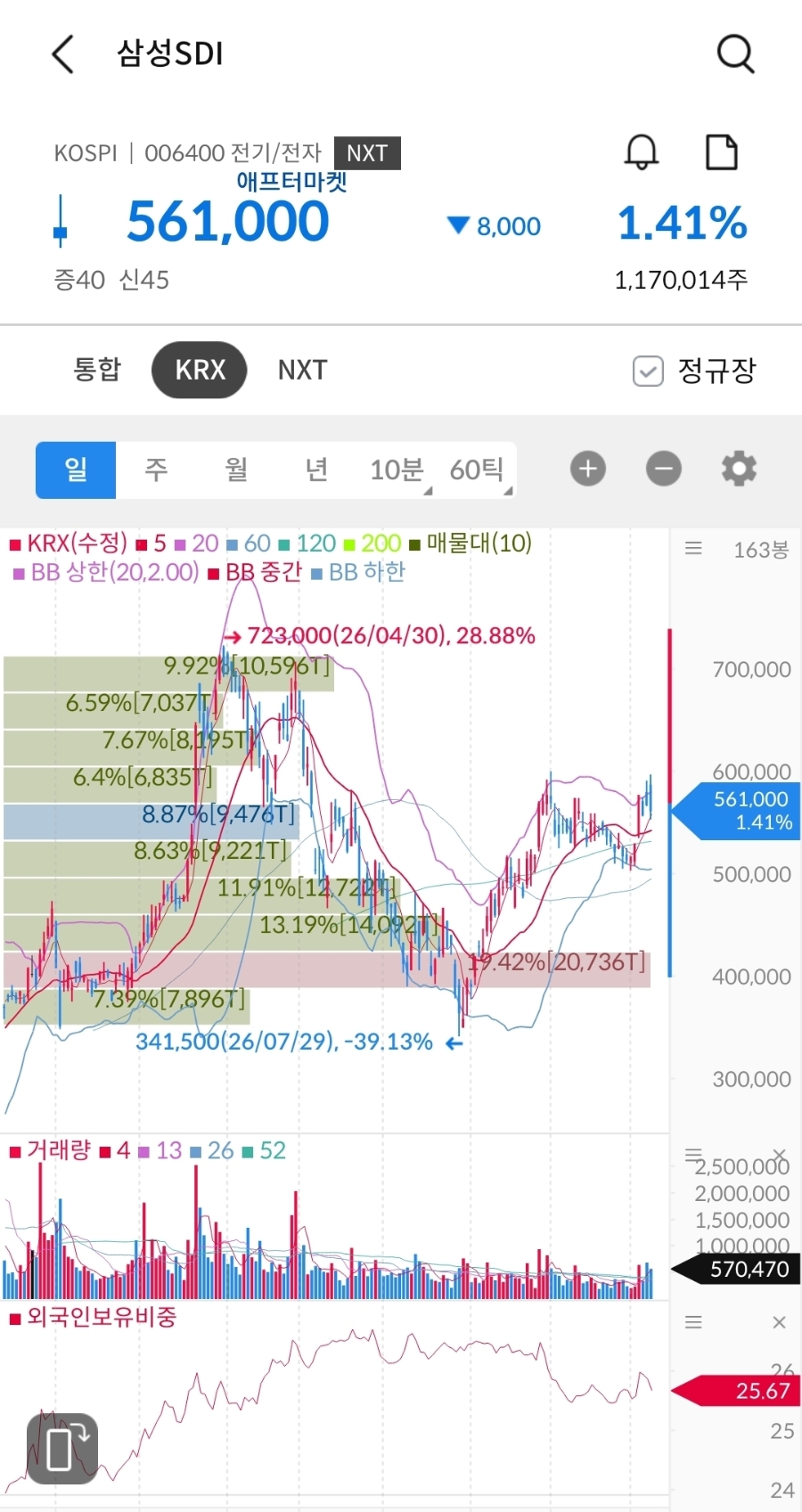
Samsung SDI (006400.KS) posted ₩203.8bn of operating profit in 2Q26, returning to the black after seven straight quarters of losses. The stock has gained 174% over the past twelve months.
Energy storage (ESS) has been a sector I follow closely even without a position.
Back in August 2025, when I wrote about the opportunity for Korean battery makers in the US BESS market, I concluded that SDI was the one to watch over LG Energy Solution. My reasoning: the prohibited foreign entity (PFE) rules in the One Big Beautiful Bill Act (OBBBA) made the exit of Chinese cells from the US market a matter of time, and with a market cap of just ₩15.5tn at the time, SDI was the name where ESS could actually move the needle on group earnings.
The problem was the risk/reward. I saw 36% downside against less than 1:1 upside, so I shelved it as “an idea to revisit as SDI’s order book builds.”
In January 2026, when ERCOT, PJM and SPP started floating curtailment measures for data center power supply, I argued that BESS would become a must-have for data centers. In July, looking at Australia’s grid, I wrote that there is no easier fix for grid stress than storage. Yet through all of that, I held zero exposure to batteries or ESS.
My earlier notes on ESS (in Korean):
- The potential of batteries (ESS) through the lens of Australia’s power market (Jul 2026)
- ERCOT, PJM, SPP curtail data center power: a tailwind for BESS and fuel cells (Jan 2026)
- If Korean battery makers have a shot in US BESS, it is probably… (LGES vs. Samsung SDI, Aug 2025)
The numbers have moved a lot since then. SDI’s market cap has gone from ₩15.5tn to ₩45.7tn (₩567,000 close on October 8).
And the recent price action across Korean battery names is hard to ignore. It’s flows and narrative moving first, not fundamentals. Stocks that used to be lumped together as “battery companies” are being re-rated as AI power infrastructure plays. This didn’t feel like a “keep watching” moment anymore, so I started a position.
Then I took SDI apart from scratch: DART filings, broker reports, flow data. The write-up got long, so I split it into three parts:
- Part 1: industry and earnings, i.e. the quality of earnings
- Part 2: turnaround stage and the delta in earnings revisions
- Part 3: valuation, technicals and my trading plan
As always, this is a record I fully expect to be wrong about in places.
1. Industry: The Growth Engine Is Shifting From EV To ESS
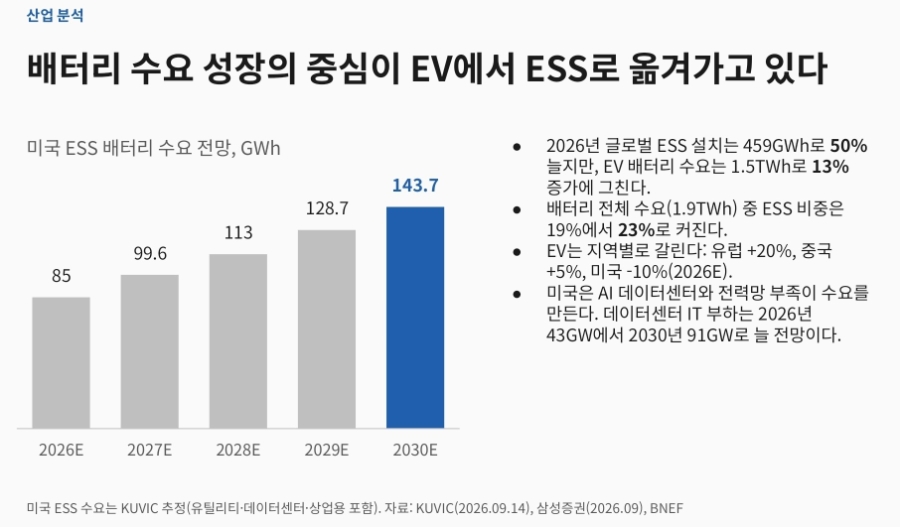
Global ESS installations are expected to grow 50% to 459GWh in 2026, while EV battery demand grows only 13% to 1.5TWh. ESS as a share of total battery demand rises from 19% to 23%.
EV demand is diverging by region: Europe +20%, China +5%, and the US -10%.
In the US, ESS demand is being driven by AI data centers and a shortage of grid capacity. Data center IT load is projected to climb from 43GW in 2026 to 91GW by 2030. With gas turbine lead times at around four years, storage is the fastest thing you can deploy, which is exactly what we saw play out in Australia.
The key is the US Section 48E investment tax credit. It requires the non-Chinese share of the supply chain to rise from 55% in 2026 to 75% by 2030. After credits, estimated installed cost is $241.5/kWh for Chinese cells vs. $135.1/kWh for Korean makers producing in the US.
Last year I said the PFE rules made a Chinese exit inevitable, and that call seems to be playing out. Some forecasts now have Chinese cells’ share of US ESS falling from 71.2% in 1H26 to just 3.9% by 2028.
SDI has signed two US ESS supply deals this year: roughly ₩3tn with Tesla (per press reports) and about ₩1.5tn with a US energy company. Both will be supplied from the StarPlus Energy plant in Indiana.
EV is the weak spot. SDI’s largest customer, BMW, has shifted its new platform toward CATL, and SDI’s EV volumes have now declined for three years running.
2. Earnings: Back In The Black, But…
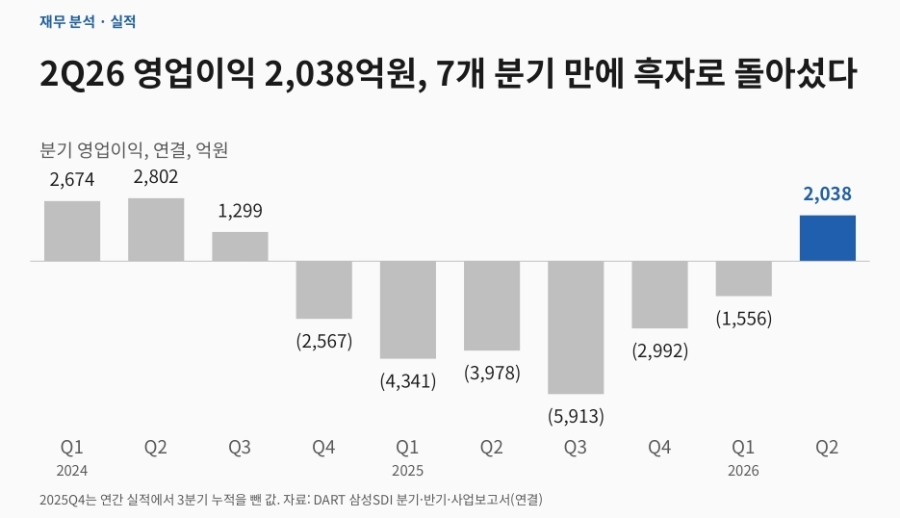
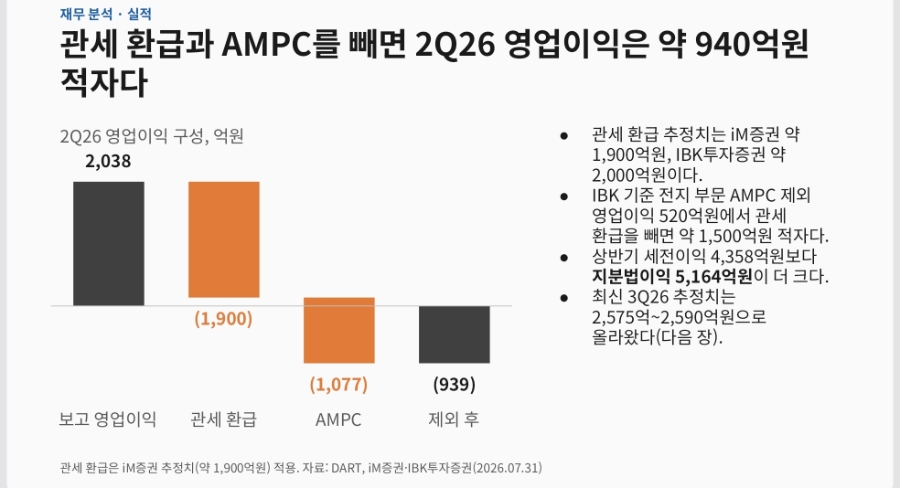
Operating profit bottomed at -₩591.3bn in 3Q25 and turned positive at ₩203.8bn in 2Q26. Gross margin recovered from 5.5% to 24.9%, above 2024 levels.
On the headline numbers, it’s a clean turnaround. Dig in, though, and the story changes.
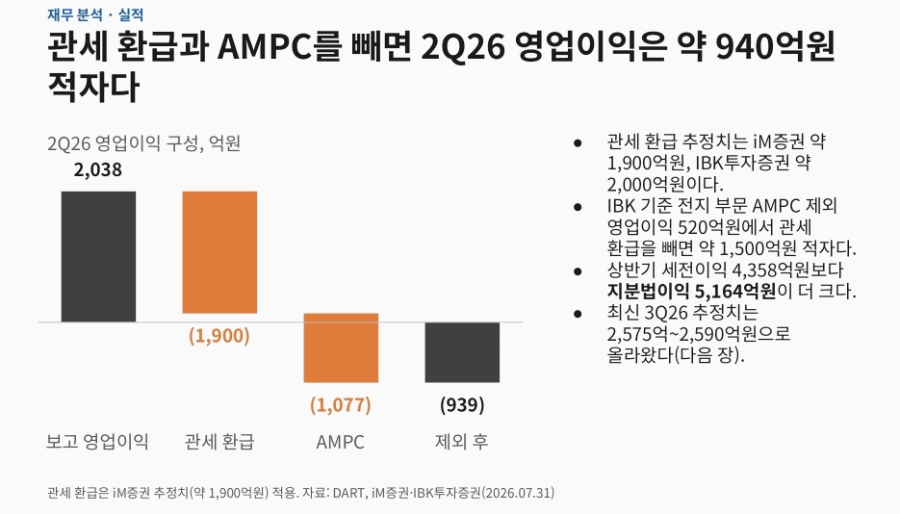
2Q26 operating profit of ₩203.8bn = ~₩190bn tariff refund + ₩107.7bn AMPC + ~-₩94bn everything else.
Excluding the tariff refund and AMPC, SDI is still loss-making. On top of that, 1H26 equity-method income (₩516.4bn) was larger than pre-tax income (₩435.8bn). In other words, most of the profit came from SDI’s stake in Samsung Display.
So what about 3Q26?
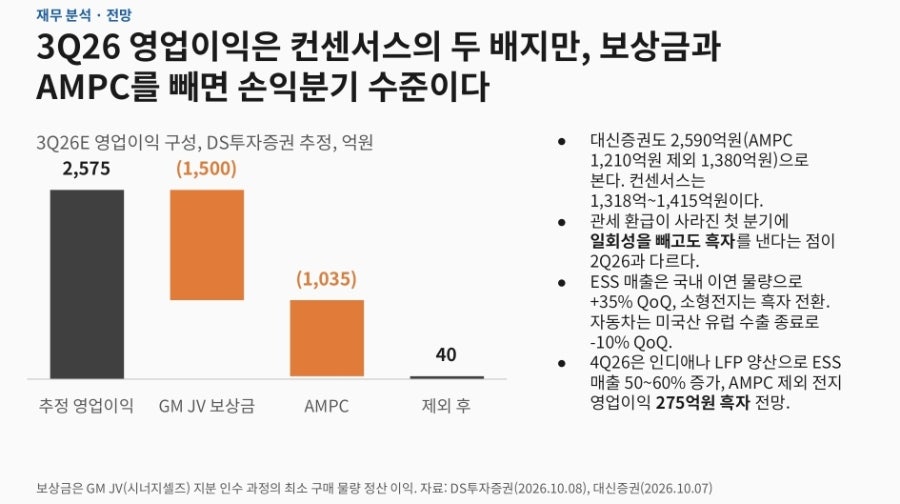
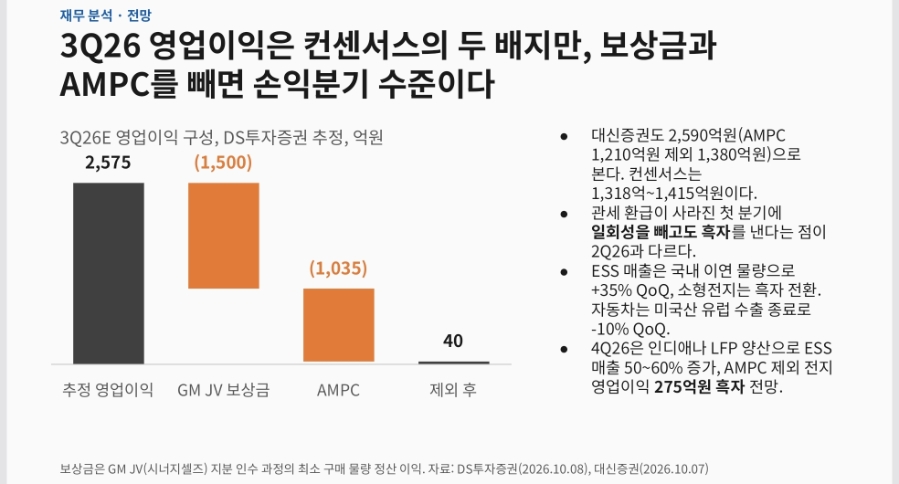
DS Investment & Securities expects ₩257.5bn of 3Q26 operating profit and Daishin Securities ₩259bn, roughly twice the consensus range of ₩131.8bn to ₩141.5bn.
But those numbers include about ₩150bn of compensation from the GM joint venture plus ₩103.5bn of AMPC. Back those out and you’re left with roughly ₩4bn. Essentially breakeven.
That’s not meaningless. 3Q26 is the first quarter without the tariff refund, and not being in the red even after excluding one-offs is a real improvement over 2Q26. ESS revenue is expected to rise 35% QoQ on delayed domestic shipments, and the small-cell business is expected to turn profitable. In 4Q26, ESS revenue could jump another 50-60% as the Indiana LFP line enters mass production.
3. Most Of 2027 Earnings Is AMPC
This is the part I struggle with most.
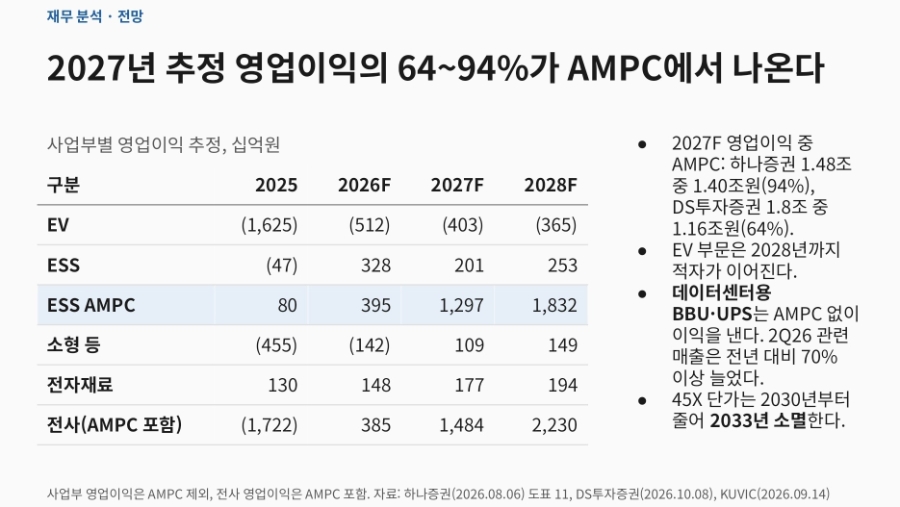
Hana Securities models 2027 operating profit of ₩1.48tn, of which ₩1.40tn (94%) is AMPC. DS Investment has ₩1.8tn with ₩1.16tn (64%) from AMPC. Estimates vary, but either way more than half of the profit is tax credits. The EV segment is expected to stay loss-making through 2028.
AMPC rates start stepping down in 2030 and phase out entirely by 2033. So if US policy shifts or the US lines ramp late, the 2027-2028 earnings outlook could be knocked over wholesale.
There’s an upside too. Data center BBUs (where SDI has roughly 50% cell share) and UPS are profitable without AMPC, and related revenue grew more than 70% YoY in 2Q26. Personally, I think we may eventually see a scenario where the market values SDI not as a “battery company” but as an “AI power infrastructure company.”
Part 1 Takeaways
- The industry direction (EV to ESS, decoupling from China) favors Samsung SDI.
- The swing to profit is real, but both 2Q26 and 3Q26 are at or below breakeven once you strip out one-offs and AMPC.
- 2027 earnings are also heavily AMPC-dependent. This is a structure that carries policy risk.
Ultimately, what matters in the late-October 3Q26 print is earnings ex-compensation and ex-AMPC.
In Part 2, I compare SDI with SK Hynix’s 2022-2024 cycle to figure out where SDI is in its turnaround.
Disclosure: I have a long position in Samsung SDI (006400.KS). This is a personal investment journal, not investment advice. Scenario probabilities and price levels are my own judgment. Do your own due diligence.


댓글 2개